

High-cycle pneumatic automation places a very different burden on connection points than a stationary compressed-air circuit. Robot grippers, packaging machines, and press automation may repeat the same movement thousands of times per shift, exposing tubing connections to pressure pulses, vibration, bending, torsion, and occasional impact.
Under these conditions, nylon pipe fittings cannot be judged only by nominal pressure or thread size. The interaction between tube material, gripping mechanism, sealing geometry, installation accuracy, and movement profile becomes equally important. DEKUMA, a manufacturer of rubber and plastic processing machinery and extrusion systems, operates within this broader materials and processing field, including equipment for multilayer tube production.
Why High-Cycle Pneumatic Connections Fatigue
Static pressure testing provides only a snapshot of connection performance. A fitting may hold compressed air without leakage during commissioning yet behave differently after months of rapid actuation. Each pressure pulse slightly changes the mechanical load on the tube wall and sealing elements, while vibration can introduce additional movement around the connection. Repeated loading can gradually reduce retention or create localized stress concentrations that are difficult to detect during ordinary inspection. This distinction is especially important for robot grippers, where pneumatic lines may move continuously with the end effector rather than remain fixed inside a machine frame.
Tube routing also determines how much mechanical stress reaches the connection. A sharp bend immediately beside the fitting concentrates deformation near the insertion point, while excessive unsupported length can allow the tube to swing with every actuator movement. Festo notes that reduced bend radius, kinking, rubbing, and mechanical interference can contribute to tubing damage in dynamic applications. Consequently, composite tube systems and conventional pneumatic tubing alike require sufficient clearance, appropriate bend radius, and controlled routing rather than relying solely on the fitting’s pressure specification.
Packaging equipment introduces another complication: speed. A sealing jaw, pick-and-place mechanism, or indexing unit can change direction abruptly, creating short-duration acceleration forces that do not appear in a static pressure rating. The connection must tolerate those mechanical events while maintaining the intended air path. A suitable nylon pipe fittings specification should consequently consider cycle frequency, tube movement, vibration amplitude, installation orientation, and the expected service interval instead of treating the connection as an isolated catalogue component.
What Separates Fatigue-Rated Connections from Standard Fittings
The key distinction lies in how the connection is evaluated over time. Standard industrial fittings are commonly specified in terms of working pressure, temperature, tube dimensions, and general compatibility. High-cycle applications require those parameters plus evidence of retention after repeated loading. Tube pull-out resistance, seal stability, body stress, and resistance to vibration become meaningful qualification criteria. Festo likewise identifies tube material, operating conditions, and environmental exposure as factors affecting service life.
Material selection deserves particular attention because stiffness and flexibility influence the way forces travel through the joint. A rigid tube may transfer more bending load into the fitting, while an overly flexible tube can move excessively around the connection. The same principle applies to a composite tube, whose layered construction can provide different mechanical behavior across its wall. Designers should examine the complete tube-and-fitting combination rather than assuming that dimensional compatibility automatically means dynamic suitability.
Seal geometry is another dividing line. A connection designed for repeated cycling needs stable contact between the sealing element and tube surface despite small dimensional changes caused by pressure, temperature, and movement. The gripping mechanism must also hold the tube without creating excessive local deformation.
How Machine Design Changes the Specification
High-cycle qualification should begin with the machine’s actual duty profile. Engineers can estimate total cycles from strokes per minute, operating hours, and expected production days, then use that figure to define an appropriate endurance test. A circuit running 60 cycles per minute accumulates more than 5 million cycles over roughly 1,400 operating hours, illustrating why a connection that performs well during installation can face a very different mechanical history in production.
Installation quality deserves the same attention as component selection. Tube cuts should remain square, insertion depth should be controlled, and routing should avoid torsion at the fitting body. A poorly prepared tube can create a weakness that becomes more pronounced as the machine cycles. Regular inspection should focus on discoloration, surface abrasion, tube movement, leakage, and changes in the position of the connection rather than waiting for a complete pneumatic failure. In automated packaging and pressing equipment, early signs of wear can be particularly useful because maintenance windows are often limited.
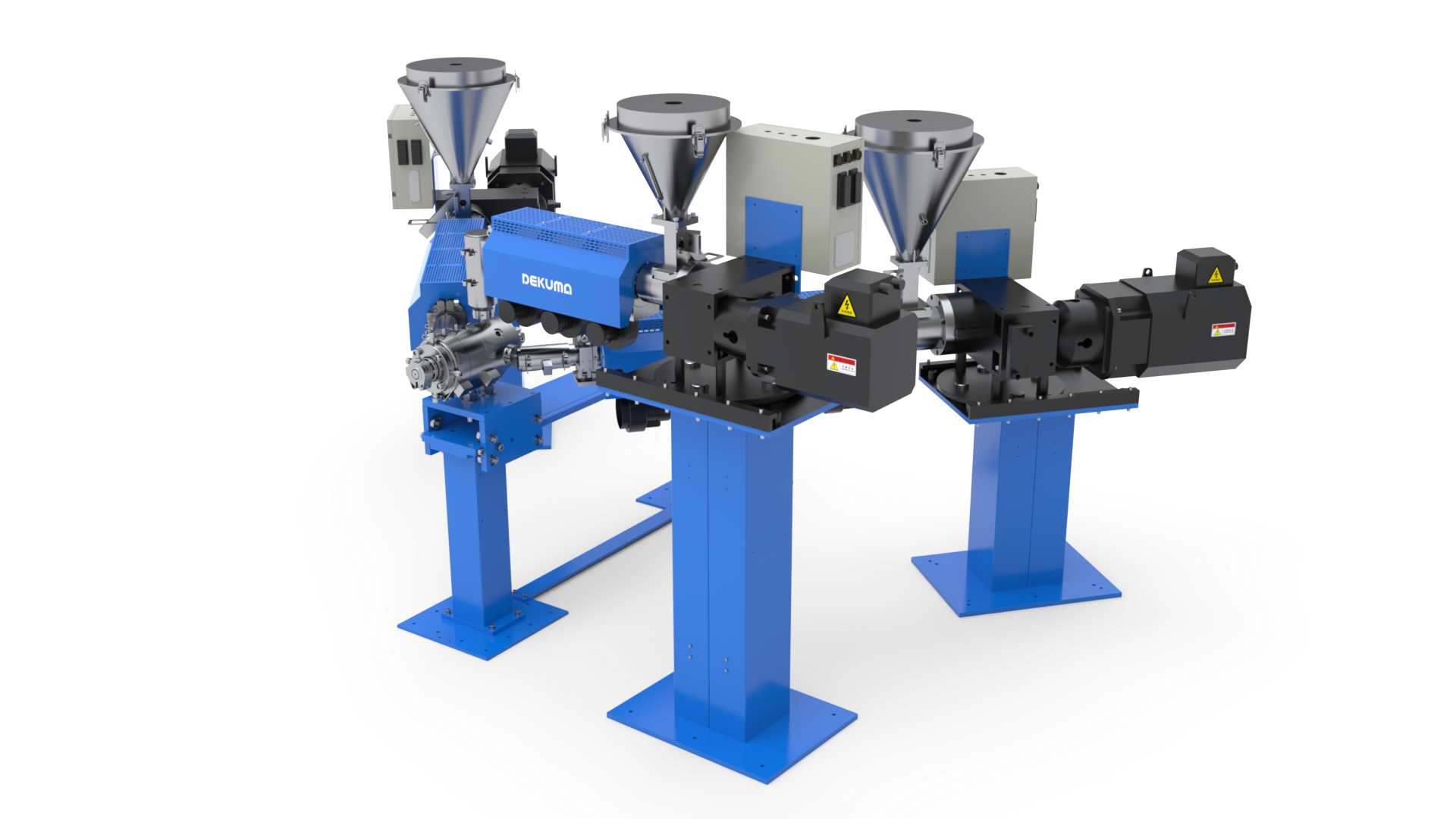
DEKUMA’s Multi-layer Nylon Composite Tube Extrusion Line provides a useful example of how multilayer tubing itself is engineered as a controlled assembly. The official configuration uses three extruders for separate inner, middle, and outer layers, with servo motors and a maximum extrusion output of 50 kg/h. Its spiral die head uses mould steel with a treated flow-channel surface, ceramic heating, temperature capability up to 300°C, an interchangeable core design, and adjustable die-to-core gaps.
Conclusion
Millions of pneumatic cycles change the meaning of reliability. A connection that looks suitable by its rating may require a much closer examination once vibration, repeated bending, acceleration, temperature variation, and long operating hours enter the specification. Nylon pipe fittings should be assessed together with the tubing, gripping mechanism, seal design, routing geometry, and documented endurance requirements. This approach is particularly relevant to robotic grippers and high-speed packaging or press equipment, where small connection problems can progressively affect actuator response and machine availability.
DEKUMA‘s experience in plastic processing equipment provides a manufacturing perspective on the relationship between material structure and tube performance. Its multilayer extrusion technology demonstrates how controlled processing can influence dimensional and structural characteristics before tubing ever reaches an automation assembly. For equipment designers, the practical lesson is broader: fatigue performance begins with the complete connection system, not with a single fitting selected from a catalogue.
